Data / Hora
Date(s) - 30/04/2026
17:00 - 18:00
Categorias
COLÓQUIO DO DEPARTAMENTO DE FÍSICA
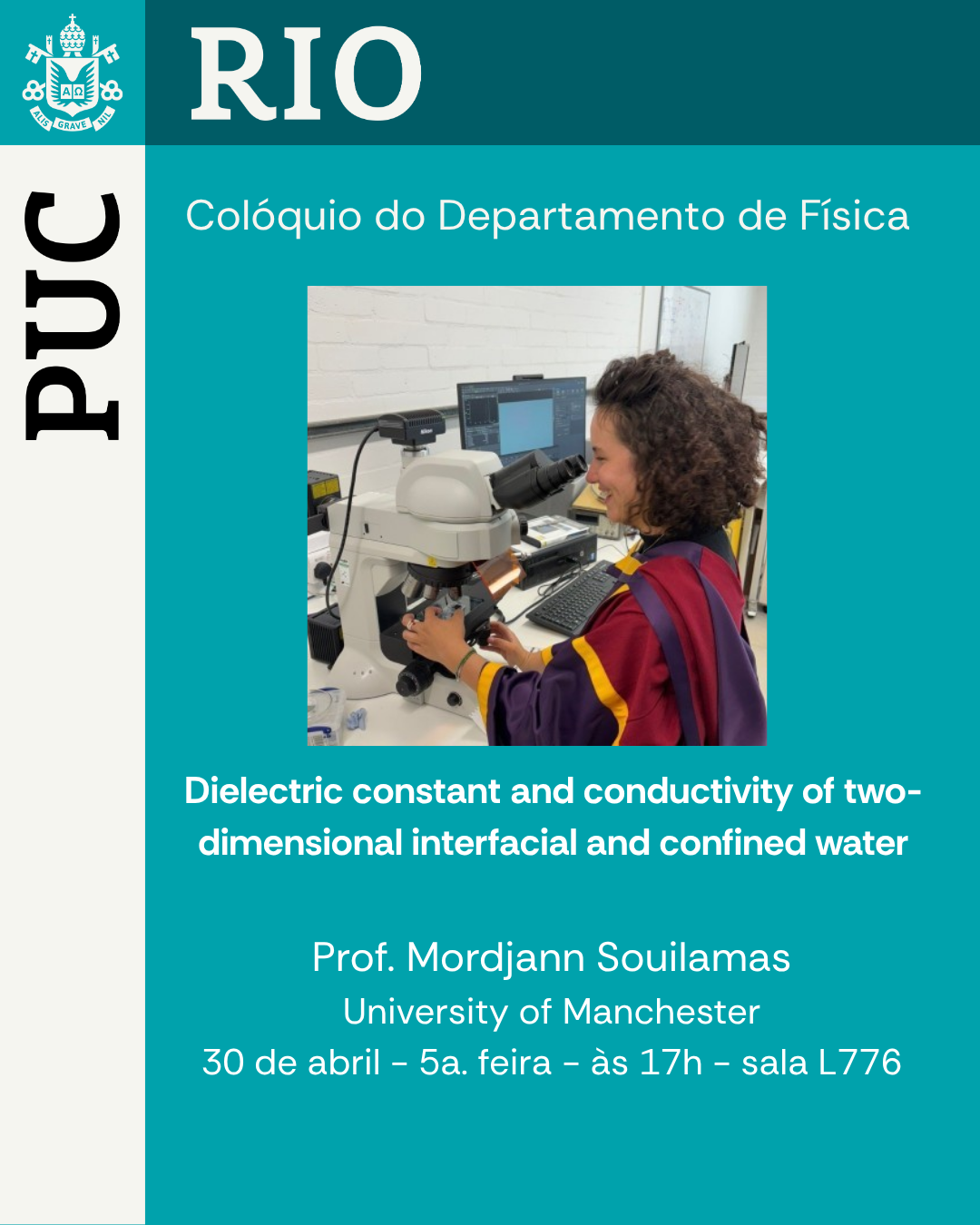
Dielectric constant and conductivity of two-dimensional interfacial and confined water
Prof. Mordjann Souilamas – University of Manchester
30 de abril – 5a. feira – às 17h – sala L776
The electrical properties of interfacial and confined water is central to a multitude of natural phenomena and technologies, from biomolecular solvation and assembly to ionic transport
across biological cells and at electrodes in batteries, to name but a few. These properties are known to be different than those observed in bulk water and, unsurprisingly, have attracted great interest for more than a century. However, little is known particularly regarding the dielectric properties of near-surface water, because of great difficulties in measuring them. This thesis investigates the dielectric properties and conductivity of water near and confined between van der Waals crystals by combining advanced two-dimensional (2D) crystal technology with scanning dielectric microscopy, an advanced scanning probe microscopy technique capable of measuring the local impedance on the atomic scale. This work builds on a previous study in which the dielectric constant of thin water layers confined in two-dimensional nanochannels made of graphite and hexagonal boron nitride (hBN) was found to be essentially suppressed in the perpendicular direction to the surfaces. Here, we addressed the more complex case of the dielectric constant in the in-plane direction of those water layers. We found that, unlike its behaviour in the out-of-plane direction, water’s in-plane dielectric constant does not decrease near surfaces but instead becomes remarkably large when confined to a thickness of 1-2 nm. Furthermore, we found that water’s in-plane conductivity increases with decreasing its thickness, reaching exceptionally high values at 1-2 nm, approaching superionic levels at room temperature. The results of this thesis are important for our understanding of interfacial water and will help to develop novel electrochemical, nanofluidic, and energy storage and production devices.